Molecular Genetics
We use advanced molecular genetics techniques to investigate complex genome regions and assess the function of genetic variants, with a major focus on the genetics of the lipoprotein(a) trait. Additionally, we enjoy exploring the potential of emerging genetic technologies like nanopore sequencing to tackle difficult genetic questions across disciplines.
Lead

Team



Lab technician (BMA) (on maternal leave)
+43 512 9003 70573
gertraud.streiter@i-med.ac.at

Project Student
Other GenEpi people involved
We work closely with the rest of the institute team and especially with Sebastian Schönherr , Lukas Forer , Hansi Weissensteiner and Florian Kronenberg .
About
We enjoy exploring the potential of emerging genetic technologies like nanopore sequencing to tackle tough genetic questions across disciplines. A special focus lies on the genetics of the lipoprotein(a) trait, where we use advanced molecular genetics techniques to dissect this complex genomic regions, identify genetic variants of the lipoprotein(a) trait and assess the function of genetic variants in-vitro. To this extend we collaborate tightly and join forces with the other research groups at the institute that investigate lipoprotein(a) such as the Lipoprotein(a) Epidemiology Group, the Computational and Digital Genomics Group and the Genome Informatics Group.
Read here more about our research on Lipoprotein(a) Genomics: Lipoprotein(a) Genomics Project Page
Nanopore Sequencing
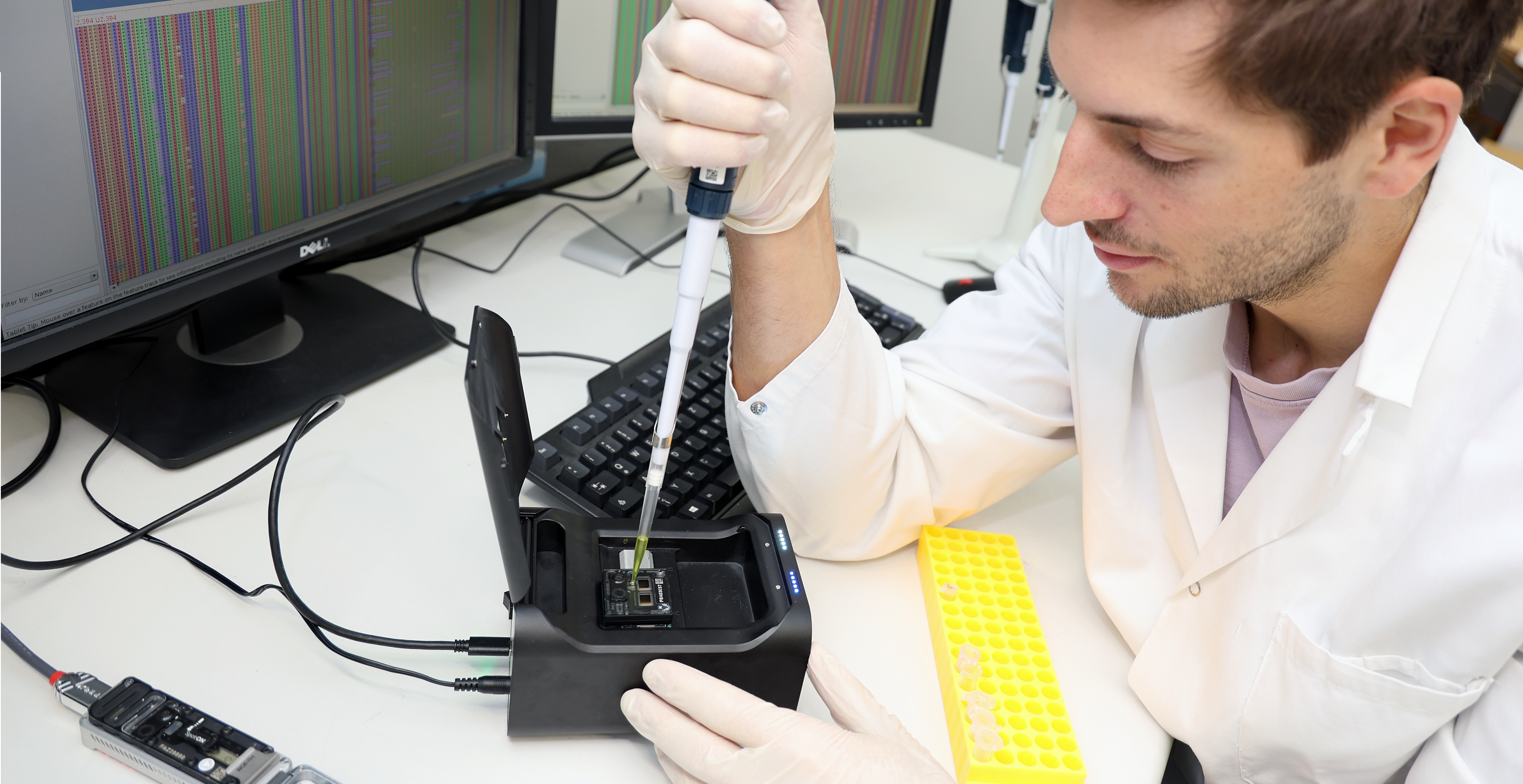
Nanopore sequencing allows sequencing DNA and RNA molecules by monitoring fluctuations in the ionic current while a DNA or RNA strand moves through a protein pore. Unlike other technologies, Nanopore sequencing provides data in real-time, allows up to megabase-sized read lengths, reads directly the native target molecule, provides true single molecule data and keeps information about epigenetic modifications. It also allows direct phasing of variants over long DNA segments, which is of special use in Lp(a) genetics. These features make it an appealing technology to target complex genes with structural variants and extensive homologies like the LPA gene. We explore applications of this technologies in Lp(a) genetics and beyond (such as human genetics, variant phasing, DNA/RNA epigenetics and metagenomics).
Technologies
- A comprehensive toolbox of advanced PCR technologies
- Nanopore sequencing (ONT MinION and PromethION P2 systems)
- Next-generation sequencing (NGS) and Sanger Sequencing
- Droplet digital PCR (ddPCR)
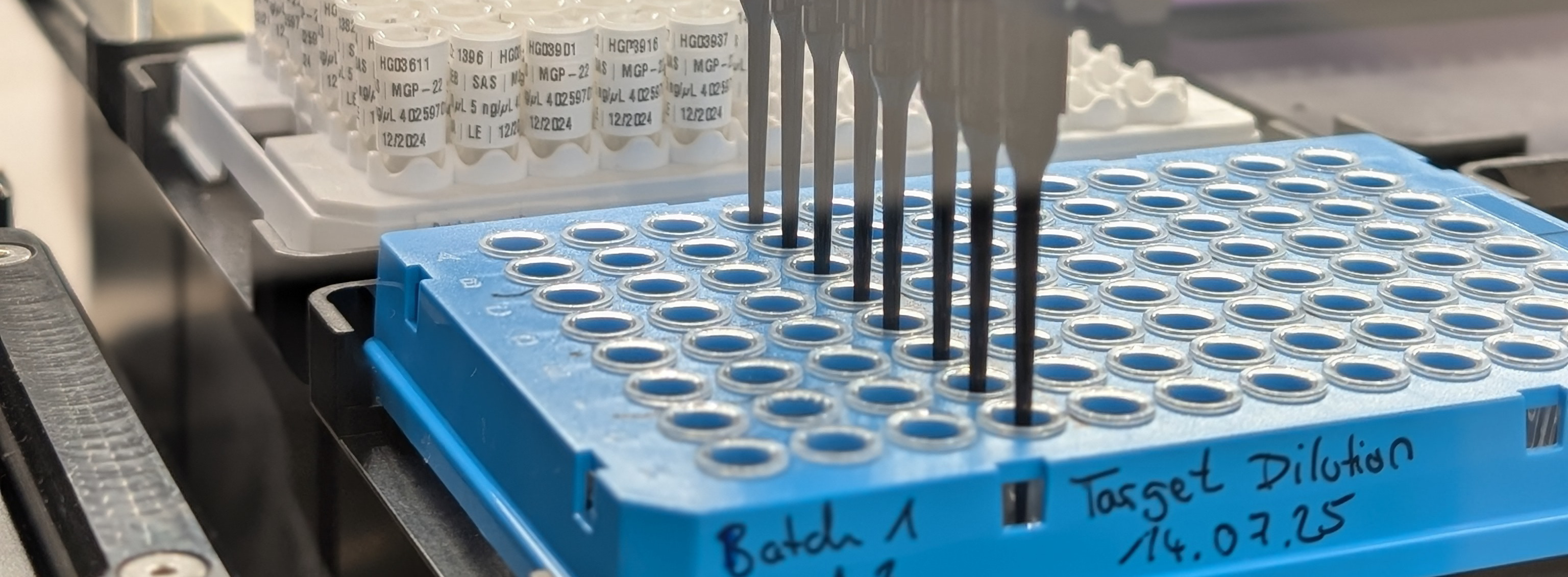
- Roboter-assisted high-throughput sample preparation, PCR/qPCR pipetting and TaqMan genotyping
- Cloning techniques, minigene splicing assays and luciferase reporter assays
- MPRA (massive parallel reporter assays) - coming soon
Additional lipoprotein(a)-specific technologies:
- High-throughput genotyping of KIV-2 variants by ddPCR, allele-specific qPCR or castPCR
- Accurate haplotyping of the variants in the LPA KIV-2 VNTR by UMI-corrected nanopore sequencing
- Pulsed-field gel electrophoresis (PFGE) (LPA allele sizing and mutation phasing, HMW DNA assessment)
- KIV-2 copy number determination by qPCR and droplet digital PCR
- HepG2 cell lines expressing various apolipoprotein(a) isoforms
Sounds interesting to you? Join us!
MolMed Lab side teaching, project studies and theses (MolMed Bachelor, MolMed Master, Medicine) available! If you are interested, contact stefan.coassin@i-med.ac.at. Available topics may involve genetic analysis of complex genome regions, methods development, applications of Nanopore sequencing and related bioinformatics, or functional characterization of SNPs.
Alumni
- Bachelor students: Johanna Schachtl-Riess (2015), Paul Bichler (2015), Gertraud Erhart (2016), Jamie Lee Losso (2016), Elisabeth Windisch (2025)
- Master students: Silvia Di Maio (2018), Peter Zöscher (2021), Stephan Amstler (2023)
- PhD students: Rebecca Grüneis (2019-2023), Silvia Di Maio (2020-2024)
- Postdoc and staff: Monika Summerer, Jamie Lee Losso
Funding and Projects
- Austrian Science Fund (FWF) PAT-5152823: Multi-ancestry LPA KIV-2 haplotype analysis and imputation (2024-)
- Intramural funding (2022-)
- Austrian Science Fund (FWF) P31458-B34: Investigation of the molecular effects of the LPA KIV-2 mutation 4925 G>A (2018-2023)
- Austrian Atherosclerosis Society: New avenues for understanding Lp(a) concentrations in families (2018-2020)
- D•A•CH-Society for the Prevention of Cardiovascular Diseases Startup grant (2015‐2017)
- Intramural funding MUI-START (2015-2017)
Key Publications
Coassin S, Kronenberg F: Lipoprotein(a) beyond the kringle IV repeat polymorphism: The complexity of genetic variation in the LPA gene. Atherosclerosis 349:17-35, 2022. PMID: 35606073 Review
Amstler S, Streiter G, Pfurtscheller C, Forer L, Di Maio S, Weissensteiner H, Paulweber B, Schönherr S, Kronenberg F, Coassin S: Nanopore sequencing with unique molecular identifiers enables accurate mutation analysis and haplotyping in the complex lipoprotein(a) KIV-2 VNTR. Genome Med. 16:117, 2024. PMID: 39380090 Journal Article
Grüneis R, Weissensteiner H, Lamina C, Schönherr S, Forer L, Di Maio S, Streiter G, Peters A, Gieger C, Kronenberg F, Coassin S: The kringle IV type 2 domain variant 4925G>A causes the elusive association signal of the LPA pentanucleotide repeat. J. Lipid Res. 63:100306, 2022. PMID: 36309064 Journal Article
Grüneis R, Lamina C, Di Maio S, Schönherr S, Zoescher P, Forer L, Streiter G, Peters A, Gieger C, Köttgen A, Kronenberg F, Coassin S: The effect of LPA Thr3888Pro on lipoprotein(a) and coronary artery disease is modified by the LPA KIV-2 variant 4925G>A. Atherosclerosis 349:151-159, 2022. PMID: 35534298 Journal Article
Schachtl-Riess JF, Kheirkhah A, Grüneis R, Di Maio S, Schoenherr S, Streiter G, Losso JL, Paulweber B, Eckardt KU, Köttgen A, Lamina C, Kronenberg F, Coassin S, GCKD Investigators: Frequent LPA KIV-2 variants lower lipoprotein(a) concentrations and protect against coronary artery disease. J. Am. Coll. Cardiol. 78:437-449, 2021. PMID: 34325833 Journal Article
Di Maio S, Grüneis R, Streiter G, Lamina C, Maglione M, Schoenherr S, Öfner D, Thorand B, Peters A, Eckardt KU, Köttgen A, Kronenberg F, Coassin S: Investigation of a nonsense mutation located in the complex KIV-2 copy number variation region of apolipoprotein(a) in 10,910 individuals. Genome Med. 12:74, 2020. PMID: 32825847 Journal Article
Coassin S, Schönherr S, Weissensteiner H, Erhart G, Forer L, Losso JL, Lamina C, Haun M, Utermann G, Paulweber B, Specht G, Kronenberg F: A comprehensive map of single-base polymorphisms in the hypervariable LPA kringle IV type 2 copy number variation region. J. Lipid Res. 60:186-199, 2019. PMID: 30413653 Journal Article
Coassin S, Erhart G, Weissensteiner H, Eca Guimarães de Araújo M, Lamina C, Schönherr S, Forer L, Haun M, Losso JL, Köttgen A, Schmidt K, Utermann G, Peters A, Gieger C, Strauch K, Finkenstedt A, Bale R, Zoller H, Paulweber B, Eckardt KU, Hüttenhofer A, Huber LA, Kronenberg F: A novel but frequent variant in LPA KIV-2 is associated with a pronounced Lp(a) and cardiovascular risk reduction. Eur. Heart J. 38:1823-1831, 2017. PMID: 28444229 Journal Article